
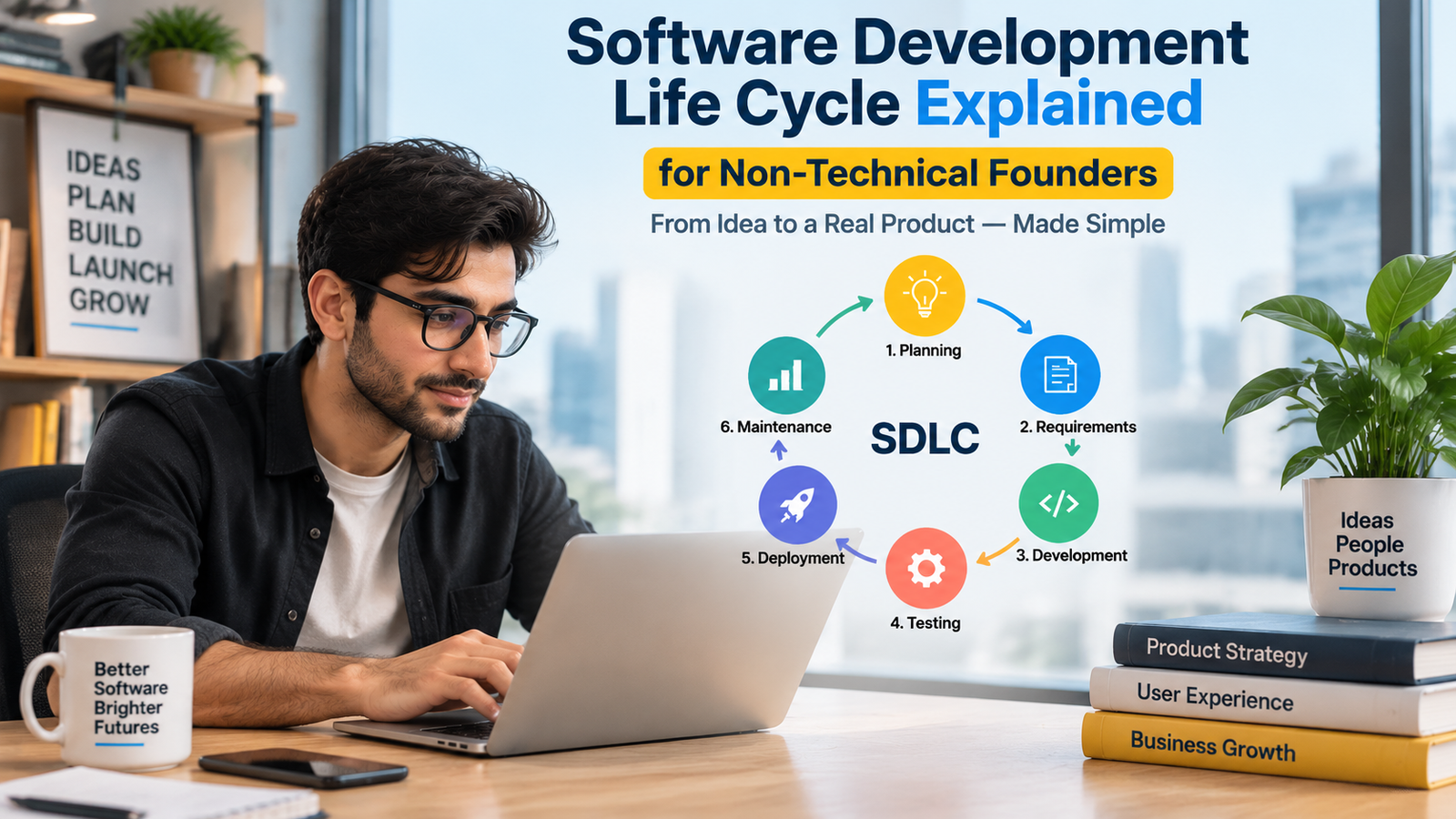
Software Development Life Cycle Explained for Non-Technical Founders
A practical 2026 guide to understanding how software moves from an idea to a reliable product
The founder’s question is usually “When will the app be ready?” |
If you are a non-technical founder, software development can feel strangely invisible. You can see a design mockup. You can watch a developer type code. You can test a demo. But the work between an idea and a dependable product is harder to see. That is where the Software Development Life Cycle, usually shortened to SDLC, becomes useful.
The SDLC is not a piece of software and it is not a rigid rulebook. It is a structured way of organising the decisions that turn a business idea into a functioning digital product. IBM describes the SDLC as a repeatable set of interdependent phases that help teams plan, build, deliver and maintain software while keeping requirements, quality, cost and stakeholder expectations aligned. Atlassian similarly presents it as a framework for planning, building, testing and maintaining software from start to finish.
For founders, the important point is simple: coding is only one part of software development. Before coding, someone must define the problem, users, scope, workflows and technical approach. After coding, someone must test the product, deploy it safely, monitor it, fix issues and improve it. When those activities are skipped or compressed, the project may still produce screens and features, but it becomes much more likely to miss the business need, overrun the budget or create expensive technical problems later.
This guide explains the SDLC in plain business language. You will see what happens at each stage, what you should expect from a development partner, where founders need to make decisions, and why the best software projects are managed as a sequence of evidence-based checkpoints rather than one long coding sprint.
What the SDLC Means in Plain English
Think about building a physical shop. You would not normally hire builders on Monday and decide where the doors, electricity, storage and checkout counter should go on Friday. You first decide what the shop needs to achieve, who will use it, how people move through it, what regulations apply, what the budget can support and what will be built first. Software needs the same discipline, even though the product is digital.
The SDLC gives the project a sequence. Different organisations use different names and may combine stages, but the logic is broadly similar: plan the product, analyse requirements, design the experience and architecture, build it, test it, release it, then maintain and improve it. In Agile teams these stages overlap and repeat in smaller cycles; in more sequential models, they happen in larger blocks. The labels matter less than the discipline of making the right decisions at the right time.
SDLC Phase | What It Means for a Founder | Typical Output |
1. Planning | What problem are we solving, for whom, and within what constraints? | Goals, scope, budget assumptions, roadmap |
2. Requirements / Analysis | What must the product actually do? | User stories, workflows, acceptance criteria, requirements |
3. Design | How should the product work and how should it be built? | UX flows, UI designs, architecture, data model |
4. Development | Turn approved requirements and designs into working software. | Code, APIs, database, integrations, builds |
5. Testing | Prove that the product works, is usable and is acceptably secure. | Test results, bug fixes, release candidate |
6. Deployment | Move the approved product into a live environment safely. | Production release, monitoring, backups, launch plan |
7. Maintenance | Keep the software reliable and improve it based on evidence. | Updates, patches, new features, optimisation |
Why Founders Should Care About the SDLC
A founder does not need to become a software engineer to manage a software project well. But you do need to understand where business decisions affect technical work. The SDLC gives you a map for those decision points.
- It makes cost easier to understand. A price should relate to scope, design, development, integrations, testing, deployment and support – not just the number of screens.
- It exposes uncertainty early. If requirements are unclear, the project should acknowledge that before developers build the wrong thing.
- It creates checkpoints. You can approve a workflow, prototype or milestone before more expensive development continues.
- It improves accountability. Everyone can see what is being worked on, what is blocked, what has been accepted and what still needs a decision.
- It reduces rework. Changing a flow on a wireframe is usually cheaper than changing a database, backend logic and mobile application after launch.
- It improves product quality. Testing, security, monitoring and maintenance become planned activities instead of emergency reactions.
Phase 1: Planning – Turn the Idea Into a Business Case
The planning phase answers the question founders often skip because the product feels obvious: what exactly are we trying to achieve? A vague goal such as “build an app for restaurants” is not enough. Are you helping customers discover restaurants, helping restaurants manage orders, reducing delivery friction, creating a loyalty platform, or doing all four? Each answer creates a different product.
A useful planning conversation covers the target user, the business problem, the value proposition, core goals, assumptions, risks, budget, timeline, regulatory concerns, existing systems and what success will look like after launch. It should also define what is intentionally out of scope. This is important because early-stage software ideas naturally expand. Every stakeholder can think of one more useful feature; without boundaries, the first version never feels complete.
For a startup, this phase is also where the team decides whether the first release should be a prototype, an MVP or a more complete commercial product. The right answer depends on risk. If the biggest uncertainty is whether users want the idea, a lean MVP may be appropriate. If the software handles payments, medical information or a critical business workflow, the first release still needs strong reliability and security even if feature scope is narrow.
Phase 2: Requirements and Analysis – Define What “Done” Means
Requirements translate a business idea into behaviour the team can build and test. This is where statements such as “users should be able to book appointments” become specific questions. Can a customer select a staff member? What happens if two people choose the same time? Can appointments be rescheduled? Is payment required? Who receives notifications? What data must be stored? What can an administrator change?
Good requirements are not an attempt to predict every future feature. They are a shared understanding of the current release. Teams may document them as user stories, workflow diagrams, use cases, acceptance criteria, screen notes or a formal software requirements specification. The format should match the project; clarity matters more than bureaucracy.
A non-technical founder should pay close attention here because unclear requirements create invisible assumptions. Developers will still make decisions if the founder does not. Those decisions may be reasonable, but they may not match the business model. Your role is to explain rules, priorities, exceptions and business consequences while the technical team explains feasibility and trade-offs.
Phase 3: Design – Decide How the Product Should Work Before You Build It
Design has two major dimensions. The first is user experience: how a person moves through the product, what information appears, what actions are possible and how the interface communicates status or errors. The second is technical design: how the system will be structured underneath, including databases, APIs, permissions, integrations, infrastructure and security considerations.
For founders, clickable prototypes are especially valuable. They let you test the product logic before development becomes expensive. A prototype can reveal that a signup flow is too long, a dashboard is missing a key decision, or the checkout process asks for information users do not have. It is much cheaper to discover those problems in design than after several development sprints.
Technical architecture also affects future cost. A simple internal tool for twenty employees can be built differently from a customer platform expected to support hundreds of thousands of accounts. The development team should be able to explain architecture in business terms: what is being optimised for, what trade-offs are being accepted, how data is protected, and how the product can change if demand grows.
Phase 4: Development – Where the Product Becomes Real
Development is the stage most founders imagine when they hear “software project,” but it works best when the earlier stages have removed unnecessary ambiguity. Developers create the frontend users see, the backend logic that processes rules, databases that store information, APIs that connect systems, integrations with third-party services, and infrastructure that allows the product to operate.
In an Agile project, development is usually divided into smaller increments. A team might build authentication and user profiles first, then booking, then payments, then reporting. Each increment can be reviewed and tested. This gives founders visibility and creates opportunities to correct direction before the entire product is complete.
Do not judge progress only by how many screens appear. Some valuable work has little visual output: database design, security configuration, integration logic, automated tests, deployment pipelines and performance improvements. A strong development partner should make this work visible through demonstrations, milestone reports, issue tracking or release notes rather than asking you to trust that “the backend is almost done.”
Phase 5: Testing – Prove the Product Works Before Customers Do It for You
Testing is not a final afternoon where someone clicks every button once. It should happen throughout development. Different forms of testing answer different questions: does a component work, do systems work together, does a workflow match the requirement, does the interface work on different devices, does performance remain acceptable, and can a malicious or accidental action expose data or break the system?
Founders should be involved in user acceptance testing because technical correctness is not the same as business correctness. A payment may technically succeed, for example, while the invoice rules are wrong. A dashboard may load perfectly but show metrics in a way the operations team cannot use. Acceptance criteria from the requirements phase become especially useful here because they create an agreed definition of expected behaviour.
Security also belongs throughout the lifecycle, not only at the end. NIST’s Secure Software Development Framework recommends integrating secure development practices into whichever SDLC model a team uses. For a founder, that means security should appear in requirements, architecture, coding standards, dependency management, access control, testing, deployment and maintenance rather than as one penetration test before launch.
Phase 6: Deployment – Launch Is a Controlled Change, Not a Button
Deployment moves software from a development or staging environment into production, where real users depend on it. A good launch plan covers data migration, configuration, domain or app-store setup, environment variables, backups, monitoring, analytics, rollback procedures, support ownership and communication with users.
A founder should ask a simple question before launch: if something goes wrong, how quickly will we know and what will we do? The answer should not be “users will tell us.” Monitoring should make errors, downtime or unusual behaviour visible. Critical products may use staged releases or limited rollouts so the team can observe real-world performance before exposing every user at once.
Launch also creates operational responsibilities. Someone must know who can access production systems, where credentials are stored, who receives alerts, how backups are verified, how incidents are escalated and which third-party services the product depends on. These details may feel less exciting than a launch announcement, but they are part of owning software responsibly.
Phase 7: Maintenance – Software Is Never Really “Finished”
Once users arrive, the product starts generating evidence. Some assumptions will be right; others will not. Users will find confusing interactions, edge cases and new needs. Operating systems, browsers, APIs and dependencies will change. Security vulnerabilities will be discovered. Performance needs may grow. Maintenance is the structured work of keeping the product useful and reliable after launch.
Maintenance includes bug fixes, security patches, infrastructure changes, performance work, compatibility updates, customer support issues and new features. It also includes removing features that add complexity without value. A healthy product backlog should be based on business priorities and evidence rather than whichever stakeholder asks most loudly.
This is why founders should discuss post-launch support before the build begins. Who owns monitoring? How are urgent defects handled? What is covered by warranty? What is charged as new development? How are updates deployed? Clear answers prevent the common situation where a product launches successfully but no one has planned how to operate it.
Agile, Waterfall, Iterative and DevOps: Which SDLC Model Is Right?
The SDLC describes the lifecycle; a development model describes how the team moves through it. Atlassian notes that common approaches include Waterfall, Agile and iterative methods, while modern teams often combine Agile planning with DevOps practices for delivery and operations. There is no universally correct model. The right choice depends on uncertainty, regulation, team structure, dependencies and how often feedback can change the product.
Approach | Best When | Main Strength | Main Risk |
Waterfall | Requirements are stable and formal approvals matter. | Clear sequential milestones and documentation. | Late changes can be expensive. |
Agile | Requirements may evolve and frequent feedback is available. | Small increments, visibility and adaptation. | Can become chaotic without product discipline. |
Iterative / Incremental | The product can be built and improved in meaningful pieces. | Reduces risk through repeated learning. | Architecture can suffer if increments are poorly planned. |
DevOps-oriented | The product needs frequent, reliable releases and strong operations. | Connects development, deployment and monitoring. | Requires engineering maturity and automation investment. |
For many startups, an Agile or iterative approach is practical because learning is part of the product. The mistake is treating Agile as “we do not need requirements or planning.” Good Agile teams still define goals, acceptance criteria, design decisions and release standards. They simply make those decisions in smaller cycles and adjust as evidence changes.
Where the MVP Fits Into the SDLC
An MVP is not an alternative to the SDLC. It is a scope decision inside the lifecycle. You still plan the problem, define requirements, design the experience, build, test, deploy and maintain the product. What changes is how much functionality is included in the first release.
A useful MVP tests the most important business assumption with the smallest responsible product. It does not mean shipping careless software. A small marketplace MVP may support only one city and one payment method, but the supported transactions should still be reliable. A SaaS MVP may omit advanced reporting, but customer data and account access still need appropriate protection.
The founder’s job is to separate must-have learning from nice-to-have completeness. Ask: which feature proves the core value? Which feature is required for safety or compliance? Which can be manual behind the scenes for now? Which can wait until user behaviour shows it is necessary? That discipline protects both timeline and budget.
A Practical Example: Building a Service-Booking Platform
Imagine a founder wants to build a platform that lets customers book local home-service professionals. The initial idea sounds simple: users choose a service, pick a time and pay. The SDLC reveals the decisions hiding underneath that sentence.
- Planning: Decide whether the business is a lead marketplace, a managed booking platform or an employer of service professionals. Define the launch city, customer segment and revenue model.
- Requirements: Specify registration, service categories, provider availability, pricing rules, booking changes, cancellation policy, payments, reviews, notifications and administrator controls.
- Design: Prototype the customer booking flow and provider dashboard. Design the data model for users, jobs, schedules, payments and service areas.
- Development: Build authentication, profiles, scheduling, payment integration, notifications, admin tools and analytics in prioritised increments.
- Testing: Test booking conflicts, failed payments, cancellations, permissions, mobile devices, slow networks and edge cases such as a provider becoming unavailable after a booking.
- Deployment: Configure production systems, backups, monitoring, support channels, analytics and a staged launch for the first service area.
- Maintenance: Watch booking completion, cancellation reasons, support tickets, provider reliability and system errors; then improve the roadmap using real data.
Notice that coding is still essential, but it is surrounded by business decisions. That is the value of the SDLC for a founder: it makes the hidden work visible before hidden assumptions become expensive problems.
How Scope Changes Affect Time and Budget
Founders often hear that a “small” feature changed the timeline. The reason is that features touch several SDLC stages. Adding social login, for example, is not only a new button. It may require product decisions, new UI states, backend authentication logic, account-linking rules, privacy considerations, testing and deployment changes.
A good change-control process does not exist to block new ideas. It makes trade-offs explicit. When a new feature appears, the team should explain the impact on cost, timeline, risk and existing scope. You can then decide whether to add it, replace another feature, postpone it or test the need another way.
This is particularly important for fixed-price projects. The more the product changes after scope approval, the less meaningful the original fixed price becomes. In time-and-materials projects, flexibility is higher, but founders still need backlog discipline so the team does not spend months building lower-value ideas while the core launch keeps moving.
AI in the 2026 SDLC: Faster Work, Same Need for Judgment
AI-assisted development tools can speed up many parts of software work in 2026. Teams may use them to draft code, generate tests, summarise requirements, explore designs, create documentation, review code or accelerate debugging. That can improve productivity, especially when experienced developers use AI as an assistant rather than a substitute for engineering judgment.
For founders, AI should change expectations about efficiency, not erase the lifecycle. Generated code still needs requirements, review, testing, security checks, licensing awareness, integration with the existing system and accountability for production behaviour. The faster a team can produce code, the more important it becomes to make sure it is producing the right code.
Ask your development partner how AI is used, where human review is required, whether sensitive code or data is sent to external tools, how generated dependencies are checked and how testing protects against confident but incorrect output. The relevant question is not “Do you use AI?” It is “How do you use automation without weakening quality, security or ownership?”
Common SDLC Mistakes Non-Technical Founders Should Avoid
- Starting development before the problem and user are clear. A team can build the wrong product very efficiently.
- Treating design as decoration. UX flows define behaviour and often expose missing requirements before coding.
- Approving vague requirements. If nobody can explain what happens in edge cases, developers will be forced to guess.
- Adding features continuously without changing the deadline or budget. Scope, time and cost influence one another.
- Testing only at the end. Late discovery makes defects and design mistakes more expensive to correct.
- Ignoring security until launch. Secure practices should be integrated across the lifecycle, consistent with NIST’s SSDF guidance.
- Confusing a demo with production readiness. A feature working on a developer’s machine does not prove it is monitored, backed up, secure or scalable.
- Having no owner after launch. Software needs operational responsibility, updates and improvement.
- Measuring delivery by activity instead of outcomes. Twenty completed tickets mean little if the core user journey is still broken.
- Choosing a development partner only by hourly rate. Process quality, communication, architecture and QA can change the real cost dramatically.
What a Founder Should Ask at Each Stage
Stage | Founder Question |
Planning | What problem are we solving first, and what are we deliberately not building yet? |
Requirements | How will we know this feature works from a business and user perspective? |
Design | Can I see the full user journey before we commit to implementation? |
Development | What was completed this iteration, what is blocked and what decisions do you need from me? |
Testing | What has been tested, what risks remain and what would stop us from launching? |
Deployment | How will we monitor the release, recover from failure and support early users? |
Maintenance | Which data, user feedback and operational issues will determine the next roadmap priorities? |
A Founder-Friendly SDLC Checklist
- The business problem and target user are written down clearly.
- The first release has a defined scope and explicit exclusions.
- Requirements describe important rules, edge cases and acceptance criteria.
- User flows or prototypes are reviewed before major development begins.
- The development approach, milestones and reporting rhythm are agreed.
- Source-code ownership, accounts, hosting, domains and third-party licences are clear.
- Testing includes functional, device/browser, integration, performance and security considerations appropriate to the product.
- Production monitoring, backups, access control and incident responsibility are defined.
- Launch is treated as the beginning of product learning, not the end of the project.
- Maintenance and post-launch support responsibilities are documented.
- New features are prioritised by business value, evidence and risk instead of impulse.
- The team can explain technical decisions in language the founder can understand.
Useful Backlinks & Further Reading
- IBM – What Is the Software Development Life Cycle (SDLC)? – Clear overview of SDLC phases, deliverables and models.
- Atlassian – Software Development Life Cycle: Complete Guide – Practical explanation of lifecycle stages and common development approaches.
- NIST – Secure Software Development Framework (SSDF) – Official guidance for integrating secure software practices into an SDLC.
- NIST – SSDF Project Page – Additional secure-development resources and mappings.
- KM Software Services – Explore software, web and digital product development services.
Final Thought: The SDLC Is Really a Decision-Making System
For a non-technical founder, the biggest benefit of understanding the SDLC is not learning technical vocabulary. It is learning when important decisions need to happen. Planning decides which problem deserves investment. Requirements define what the product must do. Design turns business rules into an experience and architecture. Development creates the system. Testing proves it. Deployment makes it operational. Maintenance keeps it valuable.
When those stages are visible, you can ask better questions and manage risk earlier. You do not need to tell developers how to write code. You need enough clarity to challenge assumptions, prioritise scope, approve trade-offs and recognise when the project is moving forward with evidence rather than optimism.
The strongest founder-development relationships are collaborative. The founder brings market understanding, customer context and commercial priorities; the technical team brings engineering judgment, delivery discipline and the ability to translate requirements into reliable software. The SDLC gives both sides a shared map.
Planning a Software Product? Start With the Right Process |
PLAN CLEARLY. BUILD IN STAGES. TEST BEFORE USERS HAVE TO.