HRMS Explained: How Automation Transforms HR Operations
Human resource departments are responsible for managing some of the most important aspects of an organization, from employee records and recruitment to attendance, payroll, performance management, and employee engagement. As companies grow, managing these responsibilities manually can become increasingly difficult. Spreadsheets, paper documents, emails, and disconnected systems can create delays, duplicate work, and data inconsistencies. This is why HRMS software has become an important part of modern HR operations.
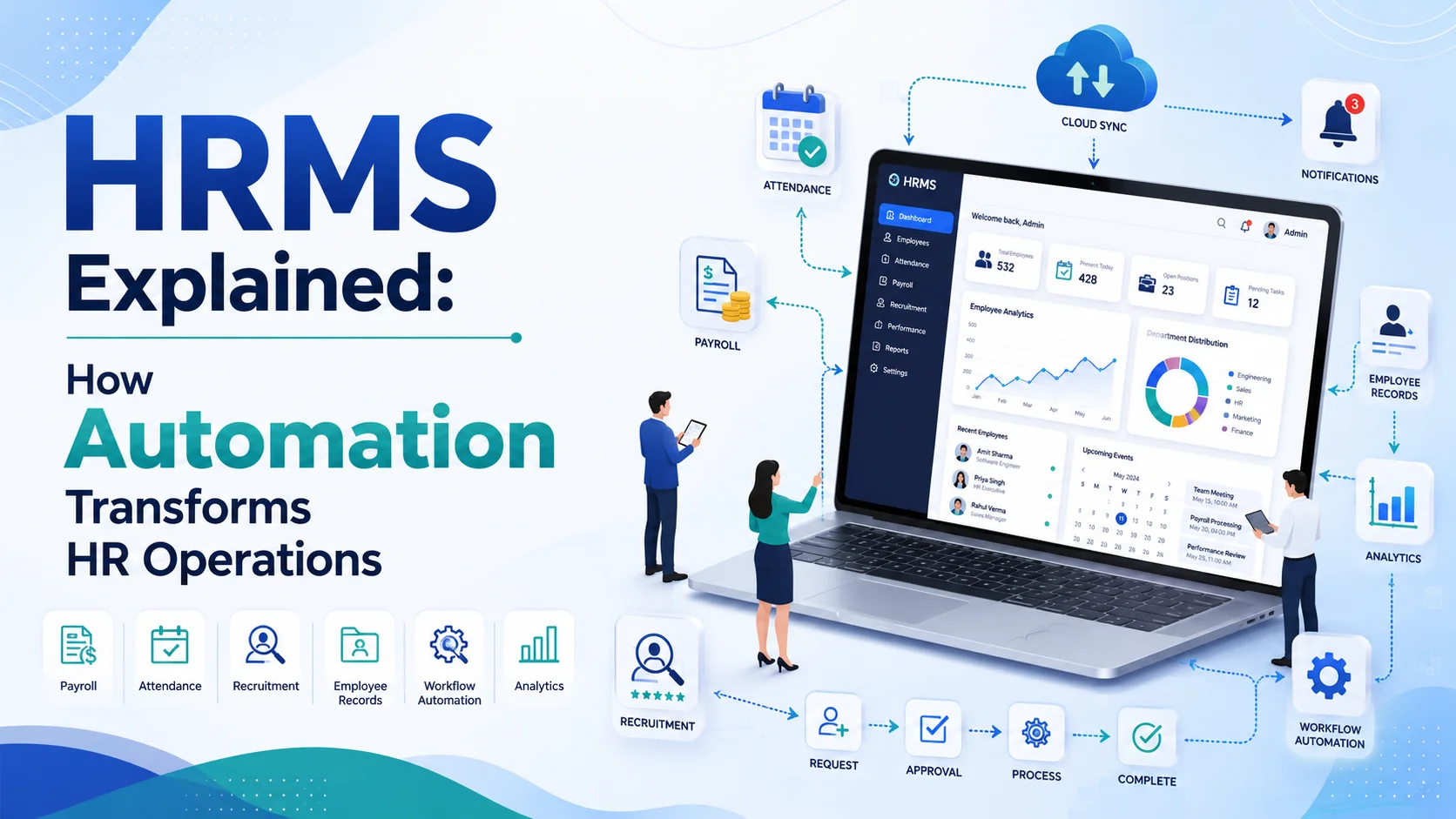
A Human Resource Management System, commonly known as an HRMS, brings multiple HR activities together within a centralized digital platform. Instead of relying on separate systems for employee information, attendance, leave, recruitment, payroll, and performance, organizations can manage many of these processes through an integrated environment. Research into human resource information systems increasingly associates digital HR platforms with automation, reduced administrative effort, centralized information, and improved organizational processes.
The importance of HRMS software is not limited to replacing paperwork. Modern HR technology can automate repetitive workflows, provide employees with self-service access, improve reporting, support better data management, and allow HR professionals to focus more attention on strategic workforce responsibilities. As digital transformation continues to influence the workplace, HR automation is becoming an important part of how organizations manage their people.
What Is an HRMS?
An HRMS is a technology platform designed to manage human resource information and processes throughout the employee lifecycle. Depending on the platform, an HRMS may include employee record management, recruitment, onboarding, attendance tracking, leave management, payroll, performance management, training, reporting, and employee self-service capabilities.
The main purpose of an HR management system is to create a centralized environment where employee information and HR workflows can be managed more efficiently. Instead of maintaining separate spreadsheets for different HR functions, authorized users can work with information stored within a structured digital system.
Modern HRMS software can also automate workflows. For example, when a new employee joins an organization, the system may initiate onboarding tasks, collect employee information, notify relevant departments, and maintain the employee’s digital record. This reduces the amount of manual coordination required from HR staff.
Why HR Operations Need Automation
Traditional HR operations often involve repetitive administrative tasks that consume considerable amounts of time. HR professionals may need to enter employee information, update attendance records, process leave requests, prepare payroll information, organize documents, send reminders, generate reports, and respond to routine employee questions.
When these responsibilities are handled manually, the possibility of human error increases. Information may be entered incorrectly, a request may be overlooked, or different departments may work with outdated records. As the workforce becomes larger, these challenges become more difficult to control.
Automation helps organizations convert repetitive activities into structured digital workflows. Instead of manually completing every stage of a process, the system can perform predefined actions when specific conditions are met. This allows HR professionals to spend less time on routine administration and more time on activities that require communication, judgment, and strategic thinking.
Recent research on HR information systems has connected HR technology with automation, reduced paperwork, improved process efficiency, and organizational performance. This makes HRMS software increasingly relevant for organizations seeking to modernize their HR operations.
How HRMS Automation Works
HRMS automation works by transforming manual HR procedures into predefined digital workflows. Information enters the system through employee requests, administrative updates, integrations, or other sources. The system then applies configured rules and routes the information to the appropriate person or department.
Consider the process of requesting leave. In a traditional environment, an employee may complete a form, send it to a manager, wait for approval, and then depend on HR staff to update the relevant records. An automated system can allow the employee to submit the request through a self-service portal. The manager can receive an automatic notification, approve the request digitally, and the employee’s leave record can then be updated according to the configured workflow.
This type of automation demonstrates how HRMS software can reduce repetitive administrative coordination while creating a clearer record of what happened during each stage of a process.
Centralized Employee Data Management
Employee information is one of the most important forms of data managed by an HR department. Personal details, job titles, departments, joining dates, employment status, compensation information, documents, leave records, and other workforce information may need to be accessed throughout an employee’s lifecycle.
When this information is distributed across spreadsheets, paper files, emails, and different applications, maintaining consistency becomes difficult. HR professionals may need to search through several systems simply to answer a basic employee-related question.
A centralized HR system provides a structured location for workforce information. Authorized users can access relevant records according to their permissions, while employees can access information that the organization makes available through self-service features.
Centralization also makes information updates more manageable. When an employee changes departments, receives a new designation, or updates certain personal information, the organization can maintain a consistent digital record rather than modifying several disconnected documents.
For this reason, HRMS software plays an important role in creating a more organized approach to employee data management.
Recruitment and Hiring Automation
Recruitment can involve significant administrative work, particularly for organizations that receive large numbers of applications. HR teams may need to publish vacancies, collect applications, organize candidate information, communicate with applicants, schedule interviews, and monitor the progress of candidates through different recruitment stages.
A digital recruitment system can centralize candidate information and create a structured hiring workflow. Instead of maintaining candidate details across multiple spreadsheets and email conversations, recruiters can manage relevant information through a single environment.
Modern HR technology can also support communication, interview scheduling, candidate tracking, and recruitment reporting. Depending on the platform, integrations with job boards and other recruitment tools can further reduce manual administration.
Research into digital HR transformation has increasingly examined automated recruitment and applicant tracking as examples of how technology can reduce repetitive work. With HRMS software, recruitment teams can spend less time organizing administrative information and more time evaluating candidates and improving the overall hiring experience.
Faster and More Consistent Onboarding
Onboarding is another HR process that can benefit significantly from automation. When a new employee joins an organization, HR may need to collect documents, create employee records, communicate policies, coordinate equipment, arrange access permissions, and notify managers or other departments.
When these activities are handled manually, important steps can sometimes be delayed or overlooked. Different employees may also experience different onboarding processes depending on which HR professional manages their joining formalities.
An automated onboarding workflow can create a standardized process. Once a new employee is entered into the system, predefined tasks can be assigned to the relevant departments and individuals. Employees may be able to complete forms, upload documents, review policies, and access important information through a digital portal.
This creates a more consistent onboarding experience while reducing administrative coordination. As an organization grows, HRMS software can help HR departments maintain standardized onboarding procedures without relying entirely on manual reminders.
Attendance and Time Management
Attendance and time management can become complicated when organizations have large teams, multiple shifts, remote employees, flexible schedules, or different working arrangements. Manual attendance records can make it difficult to maintain accurate information and connect attendance data with other HR processes.
Digital attendance systems can collect and organize time-related information according to the organization’s policies. Depending on the platform, the system may support working hours, overtime, shifts, absences, late arrivals, and other attendance-related information.
When attendance information is connected with leave and payroll processes, HR teams may not need to manually transfer the same information between different systems. This can reduce administrative effort and improve consistency.
The integration of attendance data with other workforce processes is one of the ways HRMS software can create a more connected HR environment.
Payroll Process Automation
Payroll is among the most sensitive HR processes because employees depend on accurate and timely salary payments. Payroll administration can involve salary structures, attendance, overtime, deductions, benefits, allowances, reimbursements, taxes, and other variables.
Manual payroll processing can require significant administrative effort, particularly when an organization has a large workforce. Errors can also create serious problems for both employees and employers.
Payroll automation can help centralize relevant information and reduce repetitive calculations and data entry. Depending on the system and local requirements, organizations may be able to manage payroll calculations, generate payslips, prepare reports, and connect payroll information with other business systems.
However, organizations should remember that software does not automatically guarantee legal or tax compliance. Payroll regulations differ across countries and jurisdictions, so systems must be correctly configured and regularly reviewed.
The role of HRMS software is to support payroll administration and reduce manual effort while maintaining appropriate human oversight.
Leave Management Becomes Easier
Leave management may appear simple in a small organization, but it can become increasingly complex as the workforce expands. Employees may have different leave entitlements, approval procedures, holidays, carry-forward policies, and absence rules.
Manual leave tracking can create uncertainty about available balances and may require HR employees to respond repeatedly to routine questions. Employees may also have limited visibility into whether their requests have been approved.
An automated leave management system can allow employees to submit requests digitally and managers to approve or reject them through a structured workflow. The system can then update relevant records based on the organization’s policies.
This creates greater transparency for employees and reduces repetitive administrative work for HR teams. Through HRMS software, organizations can make leave management more accessible while maintaining a centralized record of employee absences.
Performance Management and Employee Development
Performance management is increasingly moving beyond traditional annual reviews. Organizations are placing greater emphasis on continuous feedback, measurable objectives, employee development, and regular conversations between managers and employees.
A digital HR system can support this approach by maintaining employee objectives, performance reviews, feedback, development activities, and related information within a structured environment.
Managers can use digital workflows to conduct reviews and monitor objectives, while employees can access relevant information about their goals and development. Organizations can also use performance information to identify areas where employees may benefit from additional training or support.
Technology cannot replace meaningful conversations between managers and employees, but it can make the administrative side of performance management easier to manage. This is another area where HRMS software can support stronger HR processes.
Employee Self-Service
Employee self-service is one of the most practical advantages of HR automation. Instead of contacting HR for every routine question or request, employees can access certain information directly through a digital portal.
Depending on the platform, employees may be able to view payslips, check leave balances, submit leave requests, update selected personal information, access HR documents, and complete required forms.
This creates benefits for both employees and HR departments. Employees gain faster access to information, while HR professionals spend less time responding to repetitive administrative requests.
Self-service can also increase transparency because employees have greater visibility into their own HR information and requests. When implemented properly, HRMS software can therefore contribute to both operational efficiency and employee experience.
HR Reporting and Workforce Analytics
HR departments increasingly need accurate data to support organizational decisions. Management may want to understand employee turnover, absenteeism, recruitment activity, workforce size, employee demographics, compensation patterns, training participation, or other workforce indicators.
When information is stored in disconnected spreadsheets, producing accurate reports can be time-consuming. HR employees may need to collect information from several sources and manually combine it before presenting it to management.
A centralized HR platform can make reporting more efficient by organizing workforce information within a structured system. HR leaders can use reports and dashboards to identify patterns and investigate areas requiring attention.
For example, an organization may discover that employee turnover is higher within a particular department or that certain recruitment processes consistently take longer than others.
The value of HRMS software in analytics depends on the quality of the underlying data and the organization’s ability to interpret information correctly. Technology can provide information, but HR professionals still need to determine what that information means.
Improving HR Productivity
One of the most important benefits of automation is the potential improvement in HR productivity. If HR professionals spend much of their working day entering information, updating spreadsheets, responding to routine questions, or preparing basic reports, they have less time for strategic workforce activities.
Automation can reduce some of this repetitive administrative workload. This gives HR teams greater opportunity to focus on workforce planning, employee development, organizational culture, leadership support, employee engagement, and talent strategy.
Recent research continues to examine how HR information systems affect organizational performance and HR processes. The broader trend suggests that digital HR tools can support a shift from purely administrative HR activities toward more strategic work.
In this context, HRMS software is not simply a digital replacement for paperwork. It can become part of a broader transformation in how HR departments organize their time and resources.
Better Data Accuracy and Fewer Administrative Errors
Manual data entry creates opportunities for mistakes. An employee’s information might be entered differently in two systems, a leave balance may not be updated, a payroll input could be missed, or a report may contain outdated information.
Automation can reduce some of these risks by standardizing workflows and limiting unnecessary duplicate data entry. When information is stored centrally, employees and authorized administrators can work with a more consistent source of information.
However, automation does not eliminate the need for data governance. Incorrect information entered into a system can still produce incorrect results. Organizations therefore need validation processes, appropriate permissions, regular reviews, and data maintenance procedures.
A well-designed HRMS software implementation can contribute to better data accuracy by establishing consistent methods for collecting, storing, and updating employee information.
Compliance and Record Management
Human resource departments operate within a range of organizational and legal requirements. These may relate to employee records, compensation, working hours, leave, documentation, privacy, and other employment matters.
Digital record management can help organizations maintain organized employee documentation and establish clearer records of HR activities. Automated reminders can also support HR teams in monitoring deadlines and recurring administrative responsibilities.
However, organizations should not assume that an HR system automatically guarantees compliance. Applicable regulations vary by country, region, industry, and employment arrangement.
HR teams must configure systems according to relevant requirements and regularly review policies and procedures. Security is equally important because HR platforms contain sensitive personal information.
Organizations implementing HRMS software should therefore consider access controls, authentication, data protection, backups, monitoring, and internal governance as part of the overall implementation.
Integration With Other Business Systems
HR processes are closely connected with other areas of an organization. Employee information may need to interact with accounting systems, payroll platforms, attendance tools, recruitment systems, learning platforms, identity management systems, benefits providers, and other applications.
Without integration, employees may need to enter the same information multiple times. HR teams may also need to manually transfer information between different systems.
Integrations can help create a smoother flow of information. For example, information about a new employee may need to reach payroll, finance, IT, and management. An integrated workflow can reduce unnecessary manual communication and improve process consistency.
The ability to connect different systems is therefore an important consideration when evaluating HRMS software for a growing organization.
Artificial Intelligence and the Future of HR Automation
Artificial intelligence is becoming increasingly important in digital human resource management. AI-enabled technologies can support recruitment, employee assistance, document processing, analytics, workforce planning, and other HR activities.
Recent research has explored the growing use of AI in HR information systems and the potential for AI to automate repetitive activities while supporting decision-making. However, AI also creates important questions about fairness, transparency, privacy, bias, and human oversight.
Organizations should therefore avoid assuming that every HR decision should be automated. Decisions involving employee selection, performance, promotion, compensation, or other sensitive areas can have significant consequences and require responsible human involvement.
The future of HRMS software will likely involve greater integration between conventional workflow automation, workforce analytics, AI-supported tools, and employee self-service capabilities.
Challenges of Implementing an HRMS
Although HR automation can provide significant benefits, implementation itself requires careful planning. Organizations may encounter challenges involving data migration, employee resistance, training, integrations, security, process redesign, configuration, and ongoing support.
One of the most important considerations is that HR technology is not simply an IT project. It changes how employees, managers, and HR professionals interact with workforce processes.
Employees therefore need to understand why the system is being introduced and how it can make their work easier. Training and communication can play an important role in encouraging adoption.
Data migration is another major concern. Existing employee information may contain duplicate, incomplete, or inconsistent records. Moving poor-quality data into a new platform does not solve the underlying problem.
Before implementing HRMS software, organizations should review their existing processes, clean important data, identify inefficient workflows, and determine which activities should be automated or redesigned.
How to Choose the Right HRMS
Selecting an HR system should begin with the organization’s actual requirements. Businesses should first understand which HR processes consume the most time, which activities generate frequent errors, and which areas employees and managers find difficult to manage.
The organization should then evaluate whether the system supports relevant functions such as employee records, recruitment, onboarding, attendance, leave management, payroll, performance management, reporting, integrations, and employee self-service.
Ease of use should also receive significant attention. A platform with numerous features may provide little value if employees find it confusing or difficult to use.
Scalability is another important consideration because the system should be capable of supporting organizational growth. Security, data privacy, implementation support, customization, integrations, pricing, and vendor reliability should also be evaluated.
The best HRMS software is not necessarily the platform with the largest number of features. It is the platform that aligns with an organization’s processes, workforce requirements, budget, and long-term objectives.
The Role of HR Teams After Automation
Automation does not eliminate the importance of HR professionals. Instead, it can change the nature of their work.
When repetitive administrative activities are automated, HR professionals can dedicate more time to responsibilities that require human judgment, empathy, communication, and strategic thinking. These responsibilities can include employee relations, leadership development, workforce planning, organizational culture, talent development, change management, and employee experience.
Technology is particularly effective at processing structured information and following predefined workflows. Human professionals remain essential when situations require context, sensitivity, negotiation, ethical judgment, or interpersonal understanding.
The strongest HR environment therefore combines automation with human expertise rather than treating technology as a replacement for people. HRMS software can provide the infrastructure that allows HR teams to focus more effectively on the human side of human resources.
Conclusion
Modern HR departments are responsible for much more than maintaining employee records. They support recruitment, onboarding, payroll, attendance, performance, employee development, workforce planning, compliance, and organizational strategy. As these responsibilities become more complex, manual processes can create unnecessary administrative pressure.
Automation provides an opportunity to simplify repetitive activities while improving access to information and strengthening workflow consistency. A centralized HR system can help organizations manage employee data, automate leave and attendance processes, support recruitment, streamline onboarding, improve reporting, and provide employees with convenient self-service capabilities.
The effectiveness of HRMS software ultimately depends on how thoughtfully it is implemented. Organizations need clear processes, accurate data, appropriate security controls, employee training, reliable integrations, and ongoing evaluation.
Technology should not be introduced simply because HR automation is popular. It should be introduced because it solves real operational problems and helps employees and HR teams work more effectively.
As artificial intelligence, analytics, cloud technology, and workflow automation continue to evolve, HR systems are likely to become even more capable. Organizations that combine these technologies with strong HR practices and responsible human oversight can create more efficient and employee-focused workplaces.
Explore Software Solutions for Modern Business Operations
Organizations looking to modernize their HR operations may also require broader technology solutions for workflow automation, software development, business process management, and digital transformation. KM Software Services can be explored by businesses seeking professional software-related solutions and technology support. Visit KM Software Services to learn more about how technology solutions can support modern business operations and help organizations build more efficient digital workflows.