
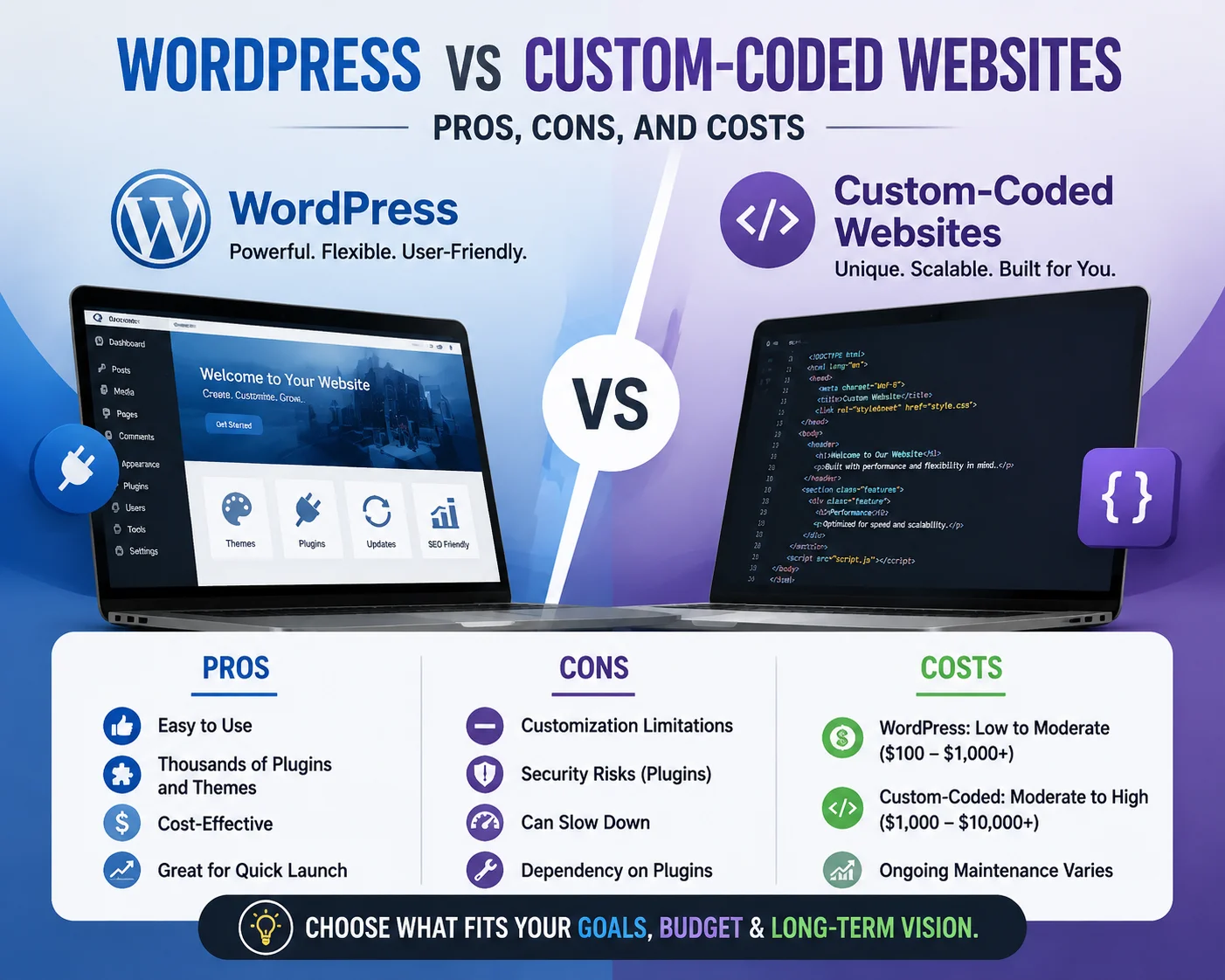
WordPress vs Custom-Coded Websites: Pros, Cons, and Costs
Choosing the right website platform is one of the most important decisions a business, professional, startup, or organization can make. Your website is not simply an online brochure; it can influence credibility, customer experience, search visibility, conversions, scalability, and long-term operating costs. Two of the most common approaches are WordPress and a website built entirely with custom code.
The decision becomes easier when you understand how WordPress vs Custom-Coded Websites differs in development time, flexibility, security, maintenance, SEO, performance, and total cost of ownership.
WordPress is a content management system (CMS) that allows users to create and manage websites without developing every component from scratch. A custom-coded website, on the other hand, is developed specifically for a particular organization, usually using technologies such as HTML, CSS, JavaScript, PHP, Python, Ruby, Java, or modern frameworks.
Neither option is automatically better for every project. The right choice depends on your goals, budget, technical requirements, content strategy, expected traffic, and future plans.
In this detailed guide, we will compare WordPress vs Custom-Coded Websites so that you can make a practical decision based on your business needs rather than simply choosing the option that sounds more advanced.
What Is a WordPress Website?
WordPress is an open-source content management system used to build and manage websites. It provides a dashboard through which administrators can publish pages, blog posts, images, products, menus, and other types of content.
One of WordPress’s biggest advantages is its ecosystem. Thousands of themes and plugins can extend the functionality of a website. Depending on the project, WordPress can support blogs, corporate websites, portfolios, membership platforms, online stores, educational websites, booking systems, and many other use cases.
For businesses that need to publish content regularly, WordPress can significantly reduce the technical effort involved in everyday website management.
A website owner does not necessarily need to contact a developer every time a new blog post needs to be published or a page needs minor content changes.
This flexibility is one reason CMS-based website development remains attractive for organizations that prioritize manageable content workflows.
What Is a Custom-Coded Website?
A custom-coded website is developed specifically around the requirements of a business or organization. Instead of relying primarily on an existing CMS structure, developers create the required functionality and interface using programming languages and frameworks.
This approach can provide a high degree of control.
For example, a company may require a highly specialized customer portal, complex calculations, custom dashboards, proprietary workflows, advanced integrations, or functionality that does not fit naturally into a standard CMS.
With custom development, developers can determine how individual components communicate and how data is processed.
However, this flexibility usually comes with greater development complexity. Custom websites can require more planning, testing, development time, documentation, and ongoing technical support.
Understanding WordPress vs Custom-Coded Websites therefore requires looking beyond the initial design and considering the complete lifecycle of the website.
WordPress vs Custom-Coded Websites: The Main Difference
The fundamental distinction is that WordPress provides an existing platform that can be customized, whereas custom development creates a solution specifically for the project’s requirements.
Think of WordPress as starting with a sophisticated foundation. You can modify the design, install additional functionality, configure settings, and extend the platform through themes, plugins, and custom code.
Custom development is more like constructing the foundation and structure according to a detailed architectural plan. Neither approach should automatically be considered superior.
If a small business needs a professional website, blog, contact forms, service pages, and straightforward SEO functionality, building everything from scratch may add unnecessary cost and complexity.
If a large organization needs highly specialized functionality that cannot be efficiently implemented through WordPress, custom development may make more sense. The best approach is the one that solves the actual problem efficiently.
Pros of WordPress Websites
- Lower Initial Development Cost
One of the biggest reasons businesses choose WordPress is its relatively accessible entry cost.
WordPress itself is open source, so there is no standard software license fee for using the core platform. However, businesses still need to budget for domain registration, hosting, premium themes or plugins where applicable, development, design, security, maintenance, and other services.
Because developers do not have to build a complete content management system from zero, development can often be faster than fully custom development.
This can be particularly useful for startups and small businesses operating with limited budgets.
When comparing WordPress vs Custom-Coded Websites, the initial financial advantage often goes to WordPress for standard websites.
- Faster Development
A WordPress website can often be launched relatively quickly because many fundamental components already exist. Developers can use established themes, plugins, templates, and integrations rather than implementing every feature independently.
A typical business website may therefore require less development time than a completely custom solution. Faster development can also mean that a business can begin publishing content, collecting leads, and serving customers sooner. For time-sensitive projects, this can be an important consideration.
- Easy Content Management
WordPress provides a user-friendly administrative interface.
After the website is configured, non-technical users can generally create and update content without editing source code. This is particularly valuable for organizations that publish articles, announcements, case studies, educational resources, product updates, or other content frequently.
A marketing team can manage many routine publishing tasks independently instead of depending on developers for every small update. For content-driven businesses, this can reduce operational friction.
- Large Plugin Ecosystem
Plugins allow WordPress websites to gain additional functionality.
Depending on the project, plugins can provide SEO features, forms, analytics integrations, ecommerce capabilities, caching, security features, backups, membership functionality, and much more.
However, plugins should be selected carefully. Installing too many unnecessary plugins can increase maintenance requirements and may create compatibility or performance issues. The plugin ecosystem is therefore both an advantage and a responsibility.
- Large Community and Developer Availability
WordPress has a large global community. This means businesses can usually find developers, agencies, tutorials, documentation, hosting providers, themes, plugins, and troubleshooting resources.
A company is less likely to become dependent on one individual developer simply because the underlying platform is widely used.
This can reduce certain forms of vendor lock-in and make long-term maintenance easier.
Cons of WordPress Websites
- Plugin and Theme Dependencies
WordPress’s flexibility can become a weakness when a website relies on too many third-party components. Different developers maintain themes and plugins. Updates can occasionally create compatibility problems, particularly when several components interact with one another. Businesses therefore need a maintenance process. Updates should be tested, backups should be maintained, and unnecessary plugins should be removed.
- Security Requires Ongoing Attention
WordPress itself is not inherently insecure, but its popularity makes WordPress installations a frequent target for automated attacks. Weak passwords, outdated software, vulnerable plugins, poor hosting configuration, and neglected updates can increase security risks.
A professionally maintained WordPress website should use appropriate security practices, including regular updates, reliable backups, strong authentication, secure hosting, and monitoring. Security should not be treated as a one-time task.
- Performance Can Be Affected by Poor Configuration
A poorly optimized WordPress website can become slow. Large images, excessive plugins, inefficient themes, poor hosting, third-party scripts, and inadequate caching can all contribute to performance problems. Importantly, this does not mean WordPress websites are inherently slow.
A carefully developed and optimized WordPress website can perform well. Performance depends heavily on implementation, hosting, assets, code quality, caching, and ongoing maintenance.
Pros of Custom-Coded Websites
- Maximum Flexibility
The greatest advantage of custom development is control. Developers can design functionality specifically around business requirements rather than adapting those requirements to an existing CMS structure. For companies with unusual workflows, proprietary systems, complex integrations, or specialized user experiences, this flexibility can be extremely valuable. This is one of the strongest arguments in the WordPress vs Custom-Coded Websites discussion.
- Specialized Functionality
Suppose a company needs a unique quotation engine, advanced customer dashboard, complex booking workflow, real-time data visualization, or integration with proprietary software. A custom application may be more appropriate than attempting to combine multiple WordPress plugins. Custom development allows the technical architecture to be designed around the actual requirements.
- Greater Control Over Architecture
Custom development gives engineers greater control over how the application is structured. They can decide which libraries are used, how databases are organized, how APIs communicate, how authentication works, and how individual services interact. This can be particularly important for organizations with sophisticated technical requirements.
- Potentially Leaner Code
A custom website does not necessarily need to include functionality that the project never uses. With careful engineering, developers can create a lean application containing only the required components. This may provide performance benefits in some scenarios.
However, custom coding does not automatically guarantee better performance. Poorly written custom code can be slower and more difficult to maintain than a well-optimized WordPress implementation.
Cons of Custom-Coded Websites
- Higher Development Costs
Custom development usually requires more engineering work. Developers must design the architecture, build components, implement functionality, test the application, fix bugs, document the system, and maintain it over time. This increases the initial investment. For a basic five-page business website, paying for extensive custom development may therefore offer limited additional value.
- Longer Development Timeline
Because more components are created specifically for the project, custom websites generally require more planning and development time. The timeline can increase further if the project contains integrations, user accounts, payments, dashboards, complex workflows, or third-party APIs.
- Greater Dependence on Developers
If the custom website does not have a user-friendly CMS, ordinary content changes may require developer assistance. Even when a custom CMS is included, it requires additional development and maintenance. Businesses should consider this operational requirement before choosing custom development.
- Maintenance Can Become Complex
Custom systems require technical maintenance. Dependencies need updating, security vulnerabilities need addressing, servers require management, backups need testing, and new browser or device requirements may require development work.
The original developer’s knowledge can also become important if documentation is poor. This means businesses should evaluate not just development cost but the expected lifetime cost.
WordPress vs Custom-Coded Websites: Cost Comparison
Cost is often the first issue businesses consider, but comparing only the initial development quote can be misleading.
The total cost of a website can include:
- Domain registration
- Web hosting
- UI/UX design
- Development
- Premium themes
- Plugins
- Security
- Backups
- Maintenance
- Content updates
- SEO
- Performance optimization
- Technical support
- Third-party integrations
- Future redesigns
- Feature development
A basic WordPress website may cost significantly less than a complex custom application.
However, an enterprise WordPress project can also become expensive if it requires extensive customization, premium infrastructure, advanced integrations, and specialist maintenance. Similarly, a custom website can have a high initial cost but may be justified when the website is effectively a specialized business application. Therefore, WordPress vs Custom-Coded Websites should be evaluated using total cost of ownership rather than simply asking which option has the cheaper development quote.
WordPress vs Custom-Coded Websites for Small Businesses
For many small businesses, WordPress is an attractive choice.
A typical small business may need:
- Home page
- About page
- Services
- Contact page
- Blog
- Testimonials
- Gallery
- Lead forms
- Basic analytics
- SEO functionality
There may be little justification for developing every component from scratch.
WordPress can provide a cost-effective foundation while leaving room for professional design and customization. A custom website becomes more compelling when the business requires specialized functionality that standard CMS solutions cannot provide efficiently.
WordPress vs Custom-Coded Websites for Startups
Startups should consider speed, budget, experimentation, and future requirements.
During an early stage, requirements may change frequently. A flexible CMS can allow a startup to launch quickly and test its market without spending a large amount on infrastructure. However, startups developing technology products may require a custom application from the beginning.
For example, a SaaS company, fintech platform, marketplace, or specialized data application may need architecture that goes beyond a conventional content website. The correct decision depends on what the website actually needs to do.
WordPress vs Custom-Coded Websites for Ecommerce
Ecommerce requirements vary significantly. WordPress combined with WooCommerce can provide a flexible foundation for many small and medium-sized online stores. It can support products, categories, payments, shipping, coupons, customer accounts, and numerous integrations. However, large ecommerce operations with highly specialized inventory systems, pricing engines, logistics workflows, or enterprise integrations may benefit from custom development or a specialized ecommerce platform. Businesses should evaluate transaction volume, product complexity, integrations, security requirements, and expected growth before making a decision.
Which Option Is Better for Blogging?
For blogging and content publishing, WordPress is usually a strong candidate.
The platform was designed around content management and provides an established publishing workflow. Writers can create posts, editors can review them, administrators can organize categories and tags, and teams can manage content without requiring extensive programming knowledge. A custom-coded website can certainly support blogging, but the organization would need to develop or integrate the publishing functionality. For a content-first website, that additional development may not be necessary.
Which Option Is Better for a Professional Business Website?
For a conventional professional business website, WordPress often offers a practical balance between cost, flexibility, design, content management, and maintainability.
That does not mean every business should use it.
Companies with unusual technical requirements may benefit from custom development.
The key question is not whether WordPress is more modern or whether custom coding is more professional. The question is which approach delivers the required functionality with an appropriate balance of cost, performance, maintainability, and scalability.
How to Decide Between the Two
When evaluating WordPress vs Custom-Coded Websites, ask the following questions:
What Is the Primary Purpose?
- If your main goal is publishing information, generating leads, presenting services, or running a content-focused website, WordPress may be appropriate.
- If your website needs to function as a sophisticated application, custom development deserves serious consideration.
How Much Is Your Budget?
- Budget should include both development and future maintenance.
- Do not spend the entire budget on launch while leaving nothing for security, updates, content, SEO, and improvements.
Who Will Manage the Website?
- If your marketing team needs to make regular changes, a CMS can provide significant value.
- If developers will handle all changes, custom development may be more manageable.
What Integrations Are Required?
List every external system that the website needs to communicate with.
Examples include:
- CRM systems
- Payment gateways
- Email marketing platforms
- Accounting software
- Inventory systems
- Booking platforms
- Learning management systems
- Customer databases
- Analytics tools
Complex integrations may influence the architecture significantly.
A Practical Decision Framework
A simple decision framework can make the choice easier.
Choose WordPress when:
- You need a content-focused website.
- You want to launch relatively quickly.
- You want an easy content management system.
- You have a limited or moderate budget.
- Your required functionality is available through reliable plugins or custom WordPress development.
- Your team needs to manage content independently.
Consider custom development when:
- You need highly specialized functionality.
- Your website is effectively a web application.
- You need a unique technical architecture.
- You require complex proprietary integrations.
- Your workflows cannot be efficiently represented through a CMS.
- You have the budget for long-term technical development and maintenance.
This framework makes the WordPress vs Custom-Coded Websites decision more objective.
Can WordPress Be Customized?
Absolutely.
A common misconception is that WordPress websites are limited to pre-designed themes. Professional WordPress development can include custom themes, custom plugins, custom post types, APIs, database integrations, custom templates, advanced ecommerce functionality, and bespoke user experiences. In other words, choosing WordPress does not necessarily mean accepting a generic website. A skilled development team can customize the platform substantially while retaining the advantages of a CMS.
Can a Custom Website Have a CMS?
Yes.
- Custom-coded websites can include custom content management systems or integrate established headless CMS
- This can give content teams an administrative interface while allowing developers to control the front-end architecture.
- However, developing and maintaining a custom CMS increases project complexity.
- Businesses should therefore determine whether the benefits justify the additional cost.
Common Mistakes Businesses Make
- One common mistake is choosing technology before defining requirements.
- Another is selecting a platform solely because it is inexpensive.
- Businesses can also make the mistake of focusing on visual design while ignoring performance, accessibility, SEO, security, content management, and maintenance.
- Some organizations over-engineer simple websites with unnecessary custom development.
- Others try to force highly complex applications into a CMS architecture that was not designed for their requirements.
- The solution is to define the business problem first and choose technology second.
Final Verdict: WordPress or Custom Code?
So, which option wins in WordPress vs Custom-Coded Websites?
There is no universal winner.
WordPress is often the better choice for businesses, bloggers, professionals, publishers, and organizations that need an efficient content management system with a relatively accessible development process.
Custom-coded websites are often better suited to organizations requiring specialized functionality, complex applications, proprietary workflows, or highly controlled technical architectures.
The right choice should consider initial cost, recurring cost, development time, SEO, performance, security, scalability, content management, integrations, and long-term maintenance. A website should be treated as a long-term business asset rather than a one-time design project. Before investing, write down your goals, required features, expected traffic, content workflow, budget, and future requirements. Then compare the solutions against those criteria.
In many cases, a professionally developed WordPress website provides the best balance for a conventional business presence. In other cases, custom development can deliver greater long-term value because the website is actually a complex software product.
Ultimately, the smartest decision in WordPress vs Custom-Coded Websites is not to choose the technology that sounds most sophisticated. It is to choose the technology that solves your business problem efficiently, securely, and sustainably.
Frequently Asked Questions
Is WordPress cheaper than a custom-coded website?
For many standard business websites, WordPress can have a lower initial development cost because the core CMS and a broad ecosystem of existing functionality are already available. However, the final cost depends on design, customization, plugins, hosting, security, maintenance, integrations, and ongoing support.
Is a custom-coded website better for SEO?
Not automatically. SEO depends on technical implementation, content quality, website architecture, page experience, internal linking, accessibility, structured data, backlinks, and many other factors. Both WordPress and custom-coded websites can be optimized effectively.
Is WordPress suitable for a professional business?
Yes. WordPress can support professional corporate websites, service businesses, portfolios, publications, educational organizations, ecommerce stores, and many other use cases. The quality of the implementation matters more than simply using WordPress.
Are custom-coded websites faster?
They can be, but custom code does not guarantee better performance. A well-engineered custom website may be highly optimized, while a poorly developed custom application can be slow. Similarly, a carefully optimized WordPress website can provide excellent performance.
Which option is easier to maintain?
For content-focused websites, WordPress is often easier for non-technical teams because it provides an established content management interface. Custom websites can also be easy to manage if a suitable CMS is included, but that functionality may require additional development.
Which is better for a small business?
For many small businesses, WordPress provides a practical balance between affordability, flexibility, content management, and functionality. Custom development becomes more attractive when the business requires specialized features that cannot be implemented efficiently using a standard CMS.
Which is better for a large organization?
It depends on the organization’s requirements. Large organizations can use WordPress successfully, particularly for publishing and content management. Organizations with highly specialized applications or complex enterprise workflows may benefit from custom development.
How long does a WordPress website take to build?
The timeline varies according to design, number of pages, functionality, content availability, integrations, revisions, and development requirements. A simple website can be completed much faster than a large customized WordPress platform.
How long does a custom website take to build?
Custom projects can require considerably more time because architecture, functionality, integrations, testing, and documentation may all be developed specifically for the organization. The exact timeline should be established after requirements are documented.
Should I choose WordPress or custom code for my website?
Start by defining what your website needs to accomplish. If you need a manageable content-driven website with conventional functionality, WordPress may be the more practical choice. If you need a specialized web application or proprietary functionality, custom development may be more appropriate.
Need Help With Your Professional Digital Presence?
If you need guidance beyond simply choosing a website platform, KM Sofware Services can be a useful resource for you. Whether you are building a professional identity, improving your online presentation, or planning a website having a clear strategy can make the process more effective.